The Creative Power of 5 Fire Flame Patterns and Digital Papers in Contemporary Design
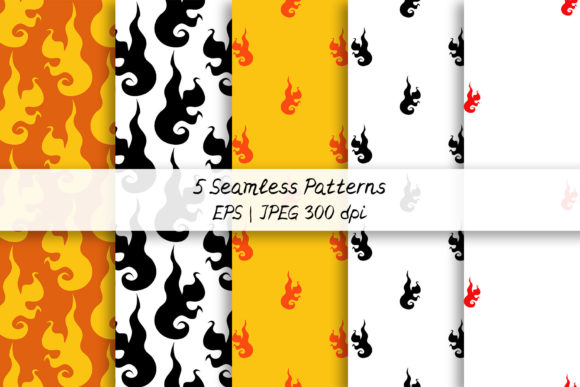
Fire has long held a magnetic pull on the human imagination. It symbolizes energy, transformation, warmth, and even danger. In the world of design, capturing that visceral energy is a challenge that many creators welcome. This is precisely where a well-curated collection of 5 Fire Flame Patterns or Digital Papers becomes an indispensable asset. These digital resources translate the organic movement and intense color gradients of fire into repeatable, scalable, and highly usable design elements. Whether you are a textile artist searching for a bold print, a brand manager looking to communicate passion and intensity, or a hobbyist crafting unique stationery, these patterns offer a shortcut to visually striking results.
What makes this particular set noteworthy is not just the subject matter but the technical foundation. Each of the 5 Fire Flame Patterns or Digital Papers is delivered as a JPEG at a massive 5000x5000 pixels with a resolution of 300 dpi, alongside an editable EPS10 vector file. This dual format bridges the gap between immediate raster use and long-term vector flexibility, making the collection suitable for both digital mockups and large-format physical printing.
Decoding the Set: What You Actually Receive
Before diving into applications, it is worth understanding the raw material. The collection comprises five distinct flame-themed designs. While the specific aesthetic of each pattern may vary—some leaning toward realistic fire photography, others toward abstract flame motifs or stylized vector fire—they share a common design DNA centered on warm color palettes, dynamic flow, and high contrast. The inclusion of 5 Fire Flame Patterns or Digital Papers in both raster and vector formats means you are not locked into a single use case. You can drop a JPEG directly into a Photoshop layout for a website background, then open the EPS10 in Illustrator to tweak the color balance, scale elements, or extract a single flame motif for a logo.
| Format | Dimensions | Resolution | Best Use |
| JPEG | 5000x5000 px | 300 dpi | Print-ready backgrounds, digital mockups |
| EPS10 | Vector (scalable) | N/A | Editing, recoloring, custom scaling |
The 300 dpi resolution is a critical detail for anyone who has ever tried to print a low-resolution web graphic. At 5000 pixels square, these files can produce prints up to roughly 16.7 inches by 16.7 inches at full quality, and even larger if the viewing distance allows for slightly lower effective resolution. For apparel designers, this means you can print a flame pattern across the entire front of a t-shirt or use it as a large-scale all-over print without pixelation.
Why Flame Motifs Resonate Across Creative Fields
Fire is one of the most emotionally charged visual elements. It evokes immediate reactions—excitement, caution, warmth, rebellion, or purification. Brands and creators leverage this emotional shorthand constantly. A flame pattern on a fitness apparel line suggests intensity and burn. On a food packaging label, it hints at spice or grilled flavor. In a music festival poster, it communicates raw energy and spectacle. The 5 Fire Flame Patterns or Digital Papers in this set provide a ready-made visual vocabulary for tapping into those associations without requiring a digital painter to render fire from scratch.
From a design psychology perspective, the color spectrum of fire—blazing yellow, orange, red, and sometimes hints of blue or purple—naturally draws the eye. These colors are high-energy and tend to dominate a composition. Used thoughtfully, flame patterns can create a powerful focal point or a dynamic background that adds depth and movement. Used carelessly, they can overwhelm a design. This is where having multiple pattern options becomes valuable: you can select a more subtle, abstract flame texture for a refined project and a bold, photorealistic fire pattern for a high-impact application.
Apparel and Textile Design
Apparel is perhaps the most intuitive application for fire-themed digital papers. Streetwear brands, athletic wear lines, and even high-fashion experimental collections have cycles where flame motifs trend heavily. The 5 Fire Flame Patterns or Digital Papers can be used as all-over prints for hoodies, leggings, and jackets. Because the JPEGs are 5000x5000 px at 300 dpi, they are print-ready for most direct-to-garment and sublimation printers. For screen printing, the vector EPS10 files allow you to separate colors and create halftones with precision. A designer working on a capsule collection might use one pattern for the main garment and a second, complementary flame pattern for sleeves or panels, creating a cohesive yet varied look.
Branding and Packaging
Branding often requires a delicate balance between recognition and versatility. A flame pattern can serve as a brand’s secondary visual element—used as a wrapping paper for a premium hot sauce, as an interior lining for a luxury candle box, or as a spot UV texture on a business card for a fire performance company. The 5 Fire Flame Patterns or Digital Papers give brand designers options to test which flame aesthetic best aligns with the brand voice. An organic, smoky flame pattern may suit a natural products brand, while a sharp, geometric flame design might fit a tech startup focused on energy solutions. The EPS10 format ensures that the pattern can be scaled and recolored to match exact brand guidelines without losing quality.
Web and Digital Interfaces
In digital design, flame patterns are often used as hero section backgrounds, loading screen animations, or decorative elements on landing pages for events, gaming platforms, or creative portfolios. The 5000x5000 pixel JPEGs are large enough to serve as full-screen backgrounds even on high-resolution Retina displays, with room to spare. However, the real advantage for web designers lies in the vector files. You can open the EPS10 in a vector editing tool, export specific elements as SVGs, and integrate them into responsive web designs with clean code. A subtle flame gradient dragged from the pattern can become a custom button background or a hover state effect that reinforces the fiery theme without overwhelming the content.
Home Decor and Stationery
Home decor enthusiasts and stationery designers often seek unique, high-impact prints. The 5 Fire Flame Patterns or Digital Papers can be used for decoupage projects on furniture, as wrapping paper for gifts, or as custom wallpaper in an accent room. The large file size means you can tile the pattern seamlessly across a wall without visible seams pixelating. For stationery, flame patterns make dramatic notebook covers, greeting cards for bold sentiments, or packaging inserts for artisanal products. A scrapbooking hobbyist might use a flame paper as a background for travel photos from a desert trip or as a thematic element in a celebration album.
DIY and Craft Projects
The accessibility of digital papers makes them a favorite in the DIY community. With the 5 Fire Flame Patterns or Digital Papers, crafters can print at home and use the sheets for card making, gift tags, decoupage on wooden boxes, or even as decorative liners for drawers and shelves. Because the set includes five distinct patterns, a single purchase can supply multiple projects. The high resolution ensures that even when printed at a small size, the detail remains crisp. For those who use cutting machines like Cricut or Silhouette, the vector EPS10 files can be imported directly, traced, and cut into custom shapes, stickers, or iron-on transfers.
Technical Advantages of the Dual Format
Understanding the difference between raster and vector is essential for getting the most out of any digital paper set. The JPEGs in this collection are raster images, meaning they are composed of pixels. At 5000x5000 px and 300 dpi, they are exceptionally high quality, but scaling them beyond their native size will eventually cause blurring. The EPS10 vector files solve that problem entirely. Vector graphics are mathematically defined, so they can be scaled up to billboard size or down to a postage stamp without any loss of fidelity. This makes the 5 Fire Flame Patterns or Digital Papers a future-proof investment: if your project requirements change, the vectors adapt.
Another practical advantage is editability. In the EPS10 file, you can change the color of the flames from orange to blue, adjust the opacity, rotate the pattern, or isolate individual flame shapes to create a new composition. This is invaluable for a designer who needs to match a specific brand palette or for a researcher creating visual stimuli for a study on color perception. The vector format also allows for clean separation of elements, which is useful for screen printing where each color requires a separate screen.
Who Benefits Most from This Collection
The versatility of this set means it serves a wide cross-section of users. Professional graphic designers will appreciate the time saved by having ready-to-use, high-resolution flame textures that they can drop into layouts and then customize via the vectors. Apparel designers can go from concept to sample faster because the patterns are already print-ready. Small business owners who handle their own packaging can elevate their product presentation with minimal effort. Educators teaching design or textile courses can use the patterns as examples of effective pattern design, color theory application, and vector versus raster workflows.
Hobbyists and crafters gain access to professional-grade materials without needing advanced software skills. Even a beginner can download a JPEG, open it in a basic photo editor, resize it, and print it for a scrapbook page or a homemade card. At the same time, advanced users can dive into the EPS10 files and manipulate every vector node. This range of usability is a key strength of the 5 Fire Flame Patterns or Digital Papers offering.
Researchers in fields like visual perception, branding psychology, or human-computer interaction might also find these patterns useful as standardized stimuli. Because the set includes both high-res raster and editable vector versions, experiments can be replicated with consistent visual materials across different display and print formats.
Practical Considerations for Using Fire Patterns
While flame patterns are visually compelling, they require thoughtful integration. The high contrast and warm color dominance can clash with certain color schemes or text readability. When using a fire pattern as a background for text, it is often wise to apply a dark or light overlay, reduce the pattern opacity, or place text within a solid-colored box. The vector files make these adjustments straightforward: you can duplicate the flame pattern and tint it, or you can create a gradient overlay directly in the EPS10 environment.
For print applications, always proof your colors. Fire reds and oranges can shift when printed on different materials. Sublimation on polyester will yield different results than inkjet on paper or screen printing on cotton. Having the vector source means you can adjust saturation and brightness to compensate for the specific substrate. Additionally, because the JPEGs are 300 dpi, they are suitable for commercial printing presses, but always check your printer’s preferred resolution—some large-format printers may request 150 dpi for billboards, and the 5000x5000 px file gives you room to downsample without losing quality.
Tiling and seamless integration is another consideration. Some digital papers are designed to tile seamlessly, meaning edges match up when repeated. If the 5 Fire Flame Patterns or Digital Papers in this set are not seamless by default, you may need to use software to create seamless tiles, especially for wallpaper or fabric applications where the pattern repeats over a large area. The vector format can simplify this process because you can arrange and duplicate elements precisely.
Integrating Flame Papers into Your Workflow
Adopting a new design asset is easiest when it fits existing workflows. For Adobe users, the EPS10 files open natively in Illustrator, and the JPEGs can be placed directly into InDesign or Photoshop. For those using Affinity, CorelDRAW, or open-source tools like Inkscape, EPS10 is widely supported. The 5000x5000 pixel JPEGs are large enough to be used as textures in 3D rendering software, applied as image maps in Blender or Cinema 4D, or used as surface patterns in CAD programs for product design.
For teams collaborating across different software, having both formats ensures compatibility. A designer might use the vector file to create a customized color variant, export that as a new JPEG for the web developer, and keep the original EPS10 as a master file in the brand asset library. This workflow flexibility reduces friction and ensures that the 5 Fire Flame Patterns or Digital Papers remain useful across the entire lifecycle of a project—from concept to production to archive.
Ultimately, the value of a digital asset lies in its ability to spark creativity without adding complexity. This collection of five fire flame patterns delivers on that promise by combining emotional visual impact with technical robustness. Whether you are designing for a global brand or a personal craft project, the combination of high-resolution JPEGs and editable vector files gives you the freedom to experiment, iterate, and produce work that stands out. Fire is elemental, and with the right digital tools, you can harness its energy in ways that are both practical and inspiring.